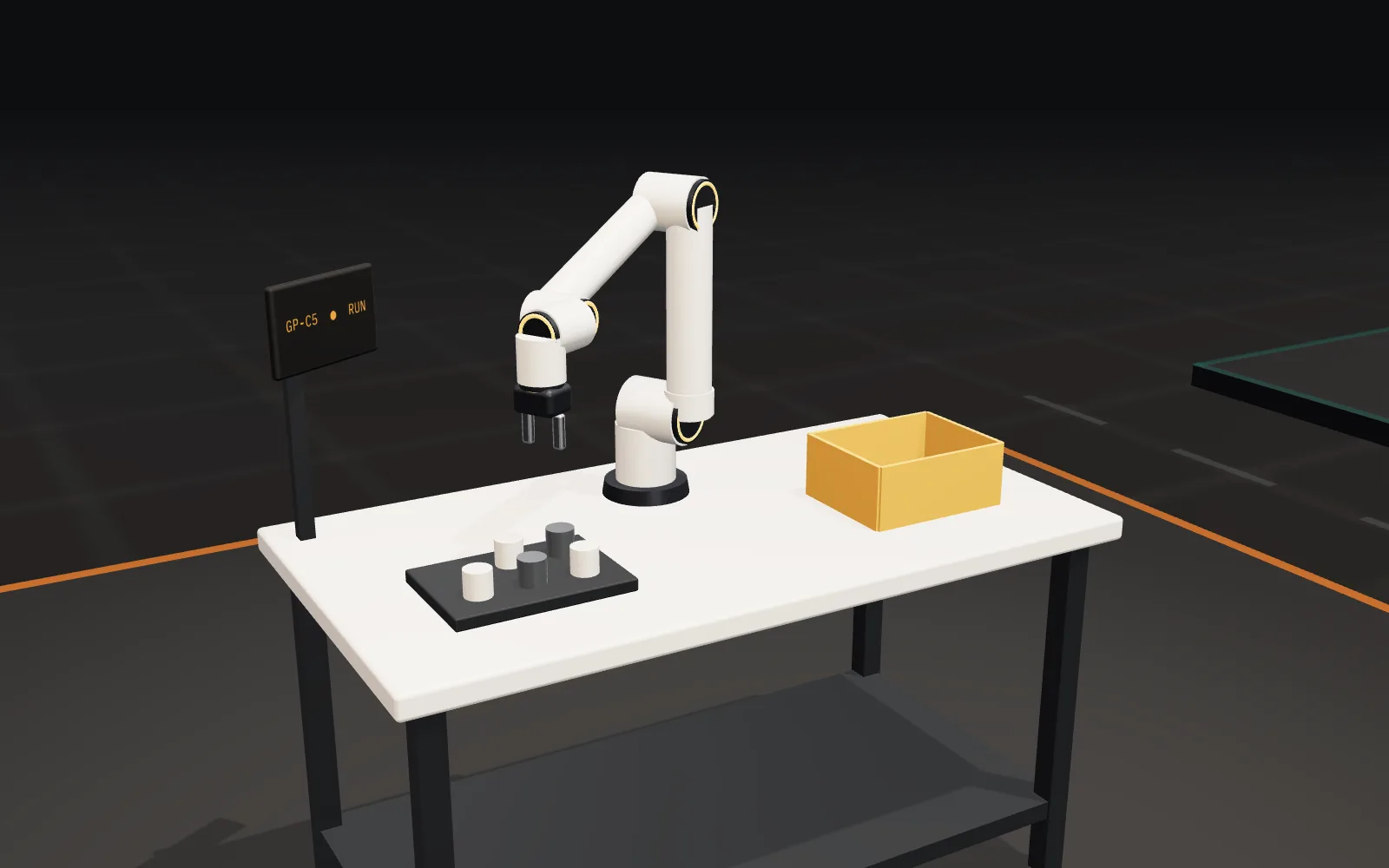
Collaborative robots (cobots) can share the workspace with operators in applications where the risk assessment allows it, and they are comparatively easy to install and re-program. A well-chosen cobot can be in production within days; a badly chosen one either cannot keep up or costs more than it should. The seven steps below help you make the decision in the right order.
1. Define the task first
Choosing a robot starts with the job, not with the robot. Before you ask for a quote, prepare answers to these questions:
- What is the part: its weight, size and surface?
- What is the target cycle time, and how many shifts a day will the cell run?
- Do parts always arrive in the same position, or do position and orientation vary?
- Will the robot share space with an operator, or work in its own cell?
- Which machines does it need to talk to (PLC, conveyor, test station)?
A short video and a few photos speed up the survey call considerably.
2. Calculate the payload properly
The payload in a catalogue covers everything mounted on the wrist: the gripper, any tool changer, cables and hoses, and the part itself. The further the centre of gravity sits from the wrist, the less the robot can safely carry, so always check the manufacturer's load diagram.
As a rule of thumb, leave a 20–30 percent margin on top of the total. A 2.5 kg part plus a 1.2 kg gripper makes 3.7 kg, which a 5 kg class cobot handles comfortably. Palletizing 8 kg boxes with a vacuum gripper, on the other hand, takes you into the 12 kg class.
3. Plan reach and layout
Reach is the distance from the centre of the robot base to the furthest point the wrist can get to. Close to the limit of its reach the robot works harder and joint angles become restricted; keeping the design within roughly 80 percent of the reach is a good starting point.
Where will the base be fixed: on the workbench, on a separate pedestal or on a mobile platform? The stiffer the base, the better the accuracy. Checking layout, reach and possible collisions in a 3D simulation before installation is the cheapest way to avoid surprises on site.
4. Speed, precision and cycle time
Repeatability (for example ±0.03 mm) tells you how closely the robot returns to the same point again and again; it is not the same as absolute positioning accuracy. It matters for assembly, screwdriving or precise placement, and is rarely a concern for tasks like moving boxes.
In collaborative operation the robot's speed and force are limited according to the risk assessment. When you estimate cycle time, use the safe working speed rather than the robot's maximum speed.
5. Safety: a "collaborative application", not just a "collaborative robot"
A robot with power and force limiting does not make the application safe by itself. A sharp-edged part, a pointed gripper or a heavy load moved quickly changes the risk completely. Every application needs a risk assessment based on robot safety standards (such as the ISO 10218 series and, for collaborative applications, ISO/TS 15066).
Depending on the outcome, you may need an area scanner, a light curtain or partial guarding. Planning for it at the start is cheaper and cleaner than adding it later.
6. Match the gripper to the part
- Vacuum grippers are fast and economical on flat, non-porous surfaces (boxes, sheet metal, glass).
- Mechanical (finger) grippers are more reliable for shaped, porous or oily parts.
- Magnetic grippers are a practical option for steel parts.
If you handle several different parts, a tool changer or a multi-purpose gripper may make sense, but every add-on increases the wrist load (step 2).
7. Programming, integration and support
Hand guiding is the feature people love most: the operator moves the arm by hand and records the points. In a real cell, though, the robot usually talks to a PLC, a conveyor, sensors or a camera. Settle the communication method (for example Modbus TCP, PROFINET or EtherNet/IP) and any vision requirement early.
Finally, operator and maintenance training, access to spare parts and remote support are what keep a robot productive on the shop floor for years.
Short checklist
| Topic | Check |
|---|---|
| Payload | Part + gripper + accessories, plus a 20–30 percent margin |
| Reach | Is the furthest point within about 80 percent of the reach? |
| Cycle time | Is the target met at a safe working speed? |
| Safety | Risk assessment and any extra guarding |
| Gripper | Suited to the part's surface and weight? |
| Integration | PLC, conveyor and camera communication |
| Support | Training, spare parts, remote support |
To see in a few minutes which cobot fits your job, try the configurator or request a survey.
This guide is for general information. Every application needs its own site survey and risk assessment.