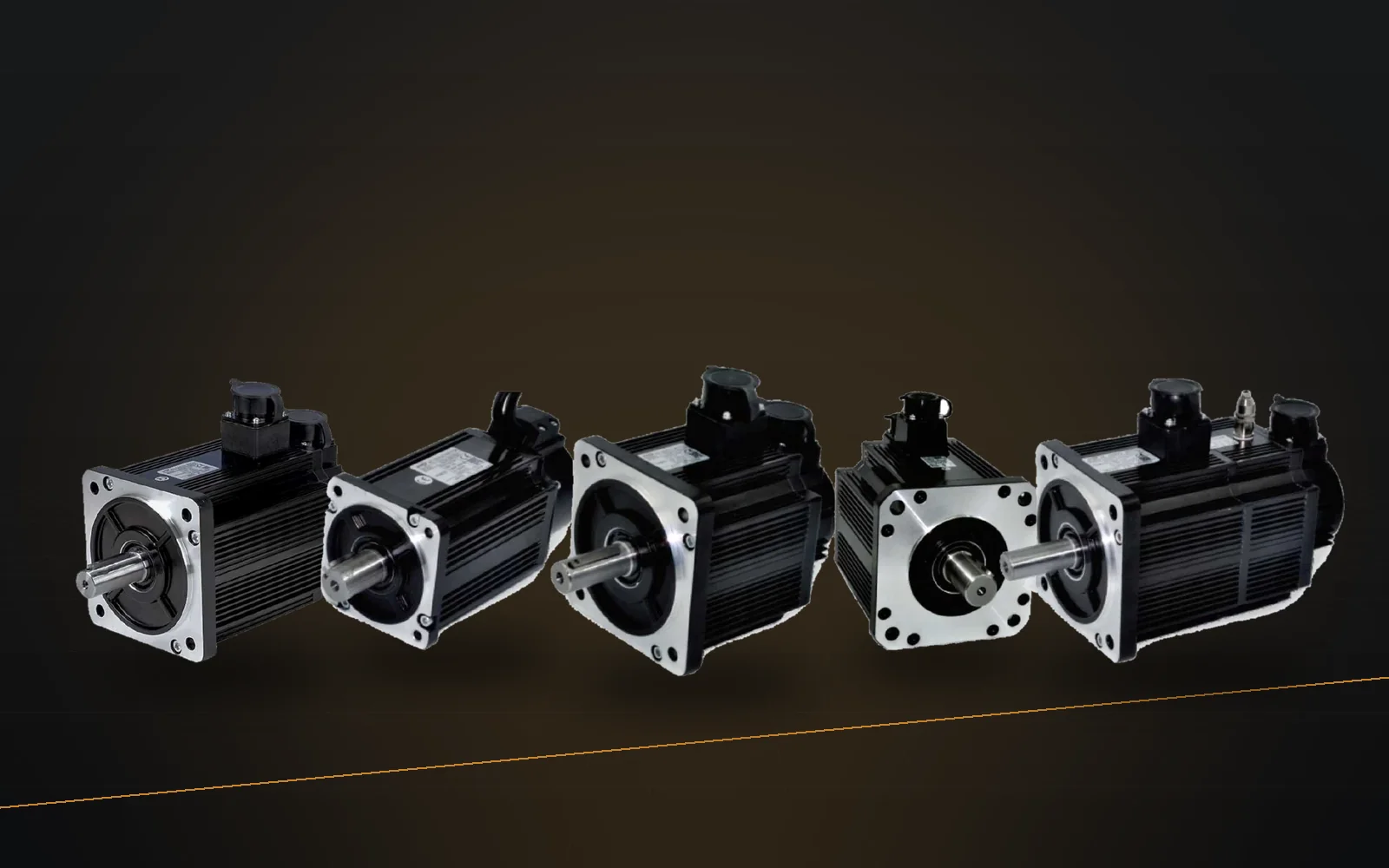
A servo motor is not chosen by its power rating alone. The right motor must deliver the continuous torque the axis needs, the peak torque during acceleration and the top speed, and it must also suit the load inertia. In this guide we work through the calculation step by step for a linear axis driven by a ball screw.
Four questions behind the choice
- Speed: how fast will the motor turn at the axis's top speed?
- Torque: how much torque is needed for friction, cutting force and acceleration?
- Heating: does the average (RMS) torque over the duty cycle stay below the motor's rated torque?
- Inertia: is the ratio of load inertia to motor inertia suitable for stable, responsive tuning?
Example axis
Consider a hypothetical milling machine table axis:
- Moving mass (table + part): 150 kg; slideway friction coefficient: 0.05
- Ball screw: Ø25 mm, 800 mm long, 10 mm lead; efficiency: 90%
- Axial force during cutting: 1,000 N
- Rapid traverse: 20 m/min; acceleration time: 0.1 s
- Duty cycle (5 s): 0.1 s acceleration, 0.5 s rapid, 0.1 s deceleration, 3 s cutting, 1.3 s dwell
Step 1: Speed
Motor speed = feed rate ÷ lead = 20,000 mm/min ÷ 10 mm = 2,000 rpm. The motor's rated speed must cover this.
Step 2: Load torques
On a ball screw, axial force is converted to torque with T = F × lead ÷ (2π × efficiency).
- Friction force: 0.05 × 150 kg × 9.81 m/s² ≈ 73.6 N → friction torque ≈ 73.6 × 0.01 ÷ (2π × 0.9) ≈ 0.13 N·m
- During cutting: (73.6 + 1,000) N → ≈ 1.90 N·m
Step 3: Load inertia
- Table inertia reflected to the motor: mass × (lead ÷ 2π)² = 150 × (0.01 ÷ 2π)² ≈ 3.80 kg·cm²
- Ball screw inertia (steel cylinder): π × density × length × diameter⁴ ÷ 32 ≈ 2.41 kg·cm²
- Coupling (estimate): 0.2 kg·cm²
- Total load inertia: ≈ 6.4 kg·cm²
Step 4: Acceleration torque and peak torque
Angular speed ω = 2,000 × 2π ÷ 60 ≈ 209 rad/s; reaching it in 0.1 s requires an angular acceleration α ≈ 2,094 rad/s². Assume a motor with a rotor inertia of 1.3 kg·cm²:
Acceleration torque = (motor inertia + load inertia ÷ efficiency) × α = (1.3 + 6.4 ÷ 0.9) × 10⁻⁴ kg·m² × 2,094 ≈ 1.76 N·m. Adding friction gives a peak torque of ≈ 1.9 N·m.
Step 5: RMS torque (heating check)
| Segment | Torque | Time |
|---|---|---|
| Acceleration | 1.89 N·m | 0.1 s |
| Rapid traverse | 0.13 N·m | 0.5 s |
| Deceleration | 1.63 N·m | 0.1 s |
| Cutting | 1.90 N·m | 3.0 s |
| Dwell | 0 N·m | 1.3 s |
RMS torque = √(Σ T² × t ÷ Σ t) ≈ 1.51 N·m. The motor's rated torque must be above this value.
Step 6: Select the motor
- With a safety factor of 1.5: rated torque ≥ 2.3 N·m, maximum torque ≥ 2.9 N·m and rated speed ≥ 2,000 rpm.
- A small motor may look sufficient on torque, but with 6.4 kg·cm² of load inertia the inertia ratio must be checked as well. Keeping the ratio below 10:1 needs a rotor inertia of at least about 0.65 kg·cm²; if you aim for around 5:1 for a more dynamic axis, a motor with about 1.3 kg·cm² rotor inertia fits.
- In this example a 110 or 130 mm flange AC servo motor is a balanced choice for both torque and inertia. In the SZGH range, 110 mm flange motors cover 2–6 N·m and 130 mm flange motors 4–15 N·m of rated torque; the exact model is confirmed against the rotor inertia and torque-speed curve in the catalog. A larger rotor inertia also raises the acceleration torque, so repeat the calculation with the catalog value of the chosen motor.
Other criteria that complete the choice
- Encoder: an absolute encoder removes the need for homing after a power loss.
- Brake: on vertical axes, a motor with a holding brake keeps the load in place when power is off.
- Drive: the matching drive and the way it talks to the controller (pulse, analog, EtherCAT or Modbus) are defined.
- Environment: protection class, temperature and cable length are checked.
For SZGH AC servo motors and SD servo drives, see our servo motors and drives page, or send us your axis data to have the motor and drive set selected together. If you are upgrading an old machine, our CNC retrofit guide will also help.
The values in the example are hypothetical and only illustrate the method. A real selection must be based on the motor and drive manufacturer's catalog data and all load cases of the application.